Classification1
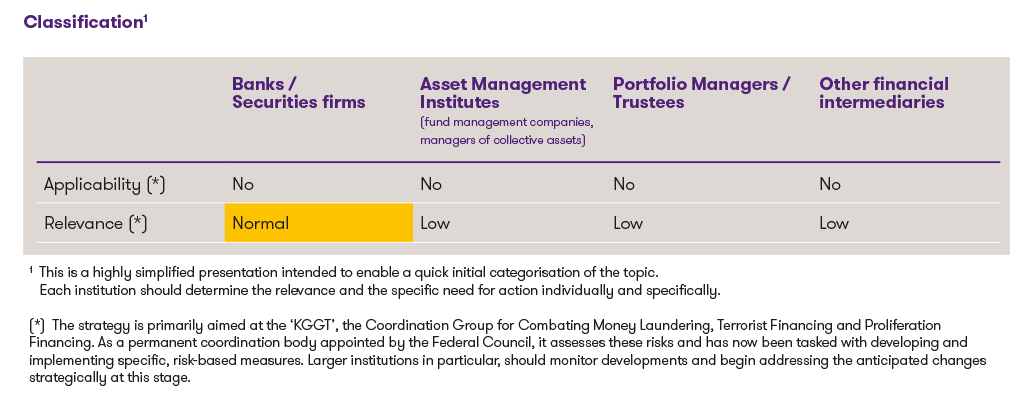
1This is a greatly simplified overview intended to provide a quick initial understanding of the subject. Each institution should determine the relevance and specific need for action on a case-by-case basis.
(*) The strategy is primarily aimed at the ‘KGGT’, the Coordination Group for Combating Money Laundering, Terrorist Financing and Proliferation Financing. As a permanent coordination body appointed by the Federal Council, it assesses these risks and has now been tasked with developing and implementing specific, risk-based measures. Larger institutions in particular, should monitor developments and begin addressing the anticipated changes strategically at this stage.
An overview of four areas for action
1. Prevention and supervision: identifying risks, creating transparency, strengthening supervision
Switzerland must at all times be aware of the risks related to money laundering and terrorist financing and take appropriate mitigating measures. An improved database and the use of modern technologies are intended to support these efforts. A key element in creating transparency is the introduction of the federal transparency register for beneficial owners, which is scheduled to become operational in the second half of 2026. Financial intermediaries will thus gain access to up-to-date information on the beneficial owners of legal entities.
In parallel, FINMA is to exercise independent, risk-based and preventive supervision and to strengthen the financial system through consistent enforcement in cases of misconduct as well as through transparent supervisory expectations. Going forward, advisers, such as lawyers and notaries, are newly subject to indirect supervision via a self-regulatory organisation.
The strategy also places greater emphasis on cooperation between the state and the private sector, which plays a key role in combating money laundering and terrorist financing. The Swiss FIPPP (Swiss Financial Intelligence Public-Private Partnership), launched in 2024, reinforces this approach by enabling MROS and various financial institutions to jointly analyse the identification of risks, patterns and suspicious activities.
2. Detection, prosecution and sanctioning: Leveraging suspicious activity reports, sanctioning breaches and strengthening law enforcement
The second area of action focuses on effectiveness throughout the entire chain, from reporting to sanctioning. In the light of the rising number of money laundering reports, the role of MROS continues to gain importance. High-quality financial intelligence, digital reporting systems and uniform data standards are intended to further enhance both the efficiency and quality of analyses.
The consistent sanctioning of violations is particularly relevant for the financial sector. Supervisory authorities are expected to be equipped with effective and deterrent enforcement tools. Measures already planned include, amongst other things, the right to impose financial administrative sanctions for FINMA as well as greater transparency in enforcement proceedings. We reported on these developments in a news article published in June 2025.
In addition, national and international cooperation among law enforcement authorities is to be further strengthened, with the aim of effectively prosecuting complex cross-border cases. New technologies and increased electronic exchange of information will play a central role in this context.
Switzerland consistently implements UN sanctions as well as numerous EU sanctions and strengthens their enforcement through close national and international cooperation, intensified information exchange, and targeted controls. New legal obligations for financial intermediaries, combined with coordinated supervision by FINMA and SECO, are intended to identify the early detection and effective prosecution of sanctions violations.
3. Asset recovery: Securing, confiscating and repatriating illicit assets
Switzerland already has various instruments and established approaches in place for the recovery of illicitly obtained assets (so-called ‘asset recovery’) and seeks to further strengthen its internationally recognised role in this field. To this end, the legal framework is being further developed, in particular with regard to the faster freezing and confiscation of suspicious assets. Transparent and clearly regulated restitution mechanisms are intended to further enhance confidence in Switzerland as a financial centre.
4. Terrorist financing: Targeted action, protection of legitimate activities
Switzerland focuses on targeted, risk-based preventive measures while explicitly taking into account the protection of legitimate activities, for example in areas such as non-profit organisations. Criminal law instruments have been significantly expanded in recent years. For instance, a specific criminal offence has been introduced covering financing in connection with recruitment, training and travel for terrorist purposes. Such activities are consistently prosecuted, sanctioned and, where necessary, supplemented by preventive measures.
Need for action and conclusion
At present, there is no immediate need for action for financial institutions, as the KGGT working group has been tasked with developing risk-based measures. Nevertheless, the strategy underscores the importance of effective processes for risk analysis and for the identification, reporting and freezing of potentially illicit assets. Larger financial institutions, in particular, are advised to closely monitor future developments.
With this new national strategy, the Federal Council is setting a clear strategic direction: an effective, risk-based, cooperative and innovative framework to safeguard the Swiss financial centre. The coming years will be characterised by the implementation phase, with a strong focus on transparency, data quality, cooperation and technological advancements. Participants in the Swiss financial centre should therefore expect that the pace of changes and innovations in anti-money laundering legislation to continue to increase.
Further information