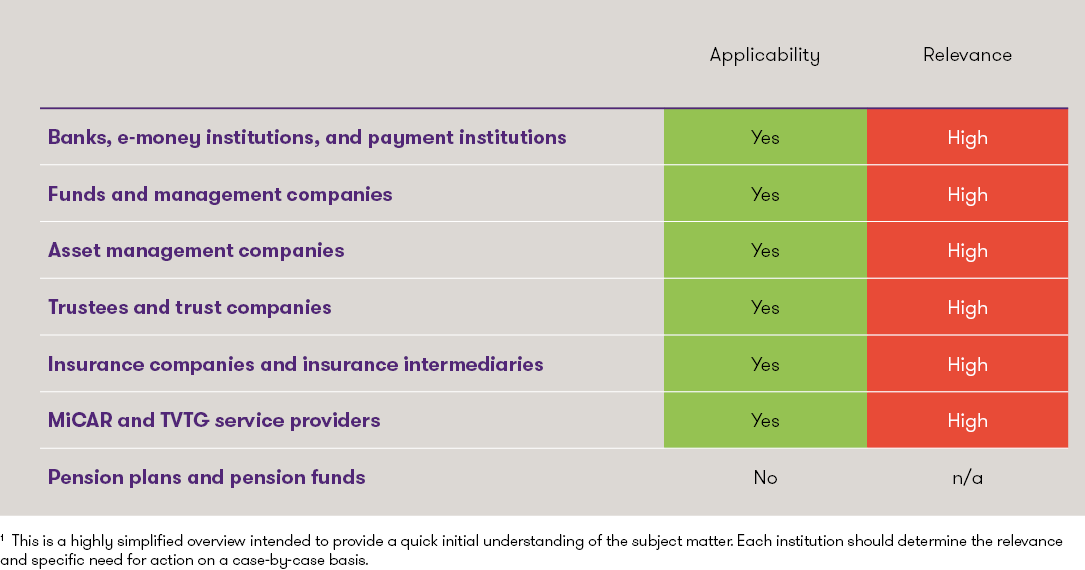
Classification1
![]()
RTS are regulatory technical standards. They flesh out the requirements of the AMLR (known as Level 1 regulations) more detail at a second level (Level 2), without altering their fundamental provisions.
RTS on Art. 19(9) AMLR: Business relationship, occasional and linked transactions
The definition of a business relationship in the AMLR has undergone hardly any changes; however, the RTS now provide guidance on when a certain regularity or duration can be assumed. Specific criteria and thresholds have been established for certain service providers and sectors (such as auditors, tax advisers, lawyers, currency exchange bureaux, payment service providers in the financial transfer business, or certain crypto-asset service providers).
An occasional transaction is defined negatively, encompassing any transaction or service that does not take place within the context of a business relationship.
When assessing eligibility and carrying out ongoing monitoring, it remains important to take into account the interconnection between transactions. The RTS provide a non-exhaustive list of criteria for this purpose; however, an overall assessment of all circumstances must be carried out. No single criterion is decisive in itself. Factors to be taken into account include:
- transactions by the same person and – to the extent known to the institution – by family members, business partners, clients acting in concert or companies within the same group;
- the use of the same digital infrastructure (e.g. IP address, device identifier) or the same intermediaries;
- transactions relating to the same purchase (e.g. same invoice or order number), via different locations or agents, within a loyalty programme, as well as interdependent transactions;
- transactions within a short period of time. Each institution determines what constitutes “short”’ on the basis of its business model and size.
Information which the ins
RTS on Art. 28(1) AMLR: Customer due diligence – what has changed since September
Our September article covered the key principles governing the identification of clients and the determination of beneficial owners. The following section outlines the amendments that have since been made, as well as selected additional content.
Complex structures
The newly introduced definition of a complex structure has been removed and replaced by a non-exhaustive list of criteria which must be taken into account when classifying such structures.
Information on intermediate companies
Where there is more than one company or legal arrangement between the client and the beneficial owner, details to be collected include, amongst other things, the legal form, nominees, country of domicile or registration, shareholdings and, where applicable, stock market listing.
Information on senior management
It is sufficient to record the company’s registered office address rather than the residential address of the natural person(s).
Check against the central register
Furthermore, a search of the central register is generally required. However, for low-risk clients, there is greater flexibility, in that a total of two sources are sufficient (e.g. the commercial register and information provided by the client).
Discretionary beneficiaries
In the case of discretionary trusts, potential beneficiaries and substitute beneficiaries must also be recorded and any changes tracked. Whether this also applies to Liechtenstein foundations remains to be seen.
Identification without physical presence
Electronic identification means under eIDAS remain the standard. Other remote solutions are only permissible if neither standard option is possible. They must meet minimum requirements, and the institution must justify why the standard method could not be applied. Article 6(3) also permits a verified copy of an identity document. It is unclear whether opening an account by correspondence using a certified copy will therefore continue to be regarded as the standard method. Affected institutions should clarify this at an early stage.
Funds (undertakings for collective investment)
If a fund distributes its units via a bank or financial institution acting in its own name on behalf of end investors, it may, under certain conditions and in accordance with Article 15 of the RTS, rely on the bank’s due diligence obligations when identifying the end investors. The fund’s previously stipulated obligation to be able to disclose the end investors immediately upon request has been removed. The provision should in principle correspond to the familiar Article 22b(3) of the SPV, but now permits its application even in business relationships involving normal risk.
Simplified due diligence requirements
In cases of low risk, proof of address is not required for natural persons; the minimum details required are name, place of birth, date of birth and nationality. For the purposes of the business relationship, the intended purpose of the transaction, the estimated transaction value where applicable, and the client’s occupation are sufficient; this information may also be derived from the product.
RTS on Art. 16(4) and Art. 17(3) AMLR: Group-wide requirement
The AMLA has combined both mandates into a single RTS because they are closely linked.
The draft regulates the following areas in particular.
- Minimum requirements for group-wide strategies and procedures (z.B. Verantwortlichkeiten und Kompetenzen Gruppen-Compliance, Umgang mit Interessenkonflikten, gruppenweite Risikobewertung und Regelungen zu Whistleblowing, Schulungen, etc.);
- Requirements for the approval of group-wide strategies, procedures and controls;
- Exchange of information within the group regarding the information listed in Annex I (scope, necessity, communication channels, group companies in third countries, etc.);
The principle that individual companies are responsible for their own due diligence and risk decisions continues to apply.
The group-wide obligations must be applied proportionately, depending on the number of obligated entities, decision-making structures, and the nature and risk of the activities. The entities subject to the requirements shall designate a “head of the structure”; in exceptional cases, the supervisory authority may permit this requirement to be waived. In such cases, common minimum standards shall apply, for example regarding risk assessment, due diligence obligations, suspicious activity reports and training. For existing structures, the notification or application must be submitted no later than six months after the RTS comes into force.
In addition, particular attention is drawn to the following provisions:
Legal obstacles in third countries
Should the law of a third country prevent or restrict the application of the AMLR to a branch or subsidiary, the institution must report the supervisory obstacle to the supervisory authority no later than 28 calendar days after it has been identified and, where legally possible, obtain the consent of its customers. If this is not possible, the institution shall take additional risk-based measures, up to and including the termination of business relationships as a last resort. If the measures prove insufficient, the supervisory authority may order further measures, up to and including the cessation of activities in the third country.
Parent companies in the Union with their head office outside the EU
Where at least two regulated entities in the EU have the same head office in a third country without being in a parent-subsidiary relationship, one of these companies must be designated as the parent undertaking in the Union and reported to the supervisory authority within 28 calendar days.
Networks, partnerships and franchises
The group obligations now also apply to “structures” which do not constitute a group within the meaning of the AMLR but which comprise at least two obliged entities, are established on a permanent basis and exhibit common ownership, common management or common compliance control. Any one of these three characteristics is sufficient; compliance control is not limited to money laundering in this context. The draft cites as typical examples networks and partnerships of auditors, accountants, lawyers and notaries, as well as franchises, such as those involving estate agents. Pure referral agreements, shared brands without management authority and shared technical platforms are not covered.
Timetable
As a directly applicable regulation, the AML Regulation is expected to replace the SPG in Liechtenstein on 10 July 2027. The associated RTS will also come into force on that date.
Impact on market participants
Although the fundamental requirements and principles for institutions and persons subject to anti-money laundering legislation will not be comprehensively altered, there will be minor or even significant deviations from the familiar requirements in some areas, namely:
- Group-wide requirements will have a broader scope: Currently, Article 16 of the SPG applies to banks and financial institutions. In future, networks, partnerships and franchises of other obliged entities may also fall under the group obligations if they share common ownership, common management or common compliance controls. Those affected should assess at an early stage whether their collaborative arrangements fall within this scope.
- Third-country entities: Institutions with branches or subsidiaries outside the EEA should review existing analyses under Article 16(3) of the SPG and Delegated Regulation (EU) 2019/758 to ensure they comply with the new, harmonised procedure.
- Funds: The relief for distribution via intermediaries has been extended compared with Article 22b(3) of the SPV, as it now also applies to standard risk.
- Distinguishing a business relationship from an occasional transaction: Trustees and other service providers, in particular, should review their mandates against the new criteria regarding duration and recurrence.
Given the scope and complexity of the new framework, affected institutions should carry out a detailed analysis of their current AML framework at an early stage in order to assess their options and identify any required action.
If you have any questions regarding the AML package or other financial market law issues, the Regulatory & Compliance Financial Services team will be happy to assist you. We look forward to hearing from you.
1 This is a greatly simplified overview, intended to provide a quick initial understanding of the subject matter. Each institution should determine the relevance and the specific need for action on a case-by-case basis.