
Directive (EU) 2025/2, known as the ‘Solvency II Review’, comprehensively modernises the European insurance supervisory regime, which has been in force since 2016, and adapts it to current economic conditions and challenges. The Government’s consultation report of 19 May 2026 sets out how these requirements are to be implemented in Liechtenstein. This article provides an initial overview of the key aspects of the draft legislation and the expected implications for market participants.
1. Context
Implementation will primarily take place through a partial amendment of the Insurance Supervision Act (VersAG) and the Insurance Supervision Ordinance (VersAV). The corresponding amendments at the ordinance level (VersAV) are currently still pending. In addition, the Persons and Companies Act (PGR), the Financial Market Supervision Act (FMAG) and the Insurance Distribution Act (VersVertG) will be amended in specific areas.
It should be noted that, for insurance undertakings, not only the Directive but also numerous implementing acts (Levels II and III) are relevant. These will become directly applicable upon their incorporation into the EEA Agreement. These include, in particular, the directly applicable Delegated Regulation (EU) 2015/35, which supplements and clarifies the key requirements of the Solvency II framework and was also revised as part of the review. This publication is limited to the legislative amendments to the Insurance Supervision Act (VersAG).
Relevance for market participants
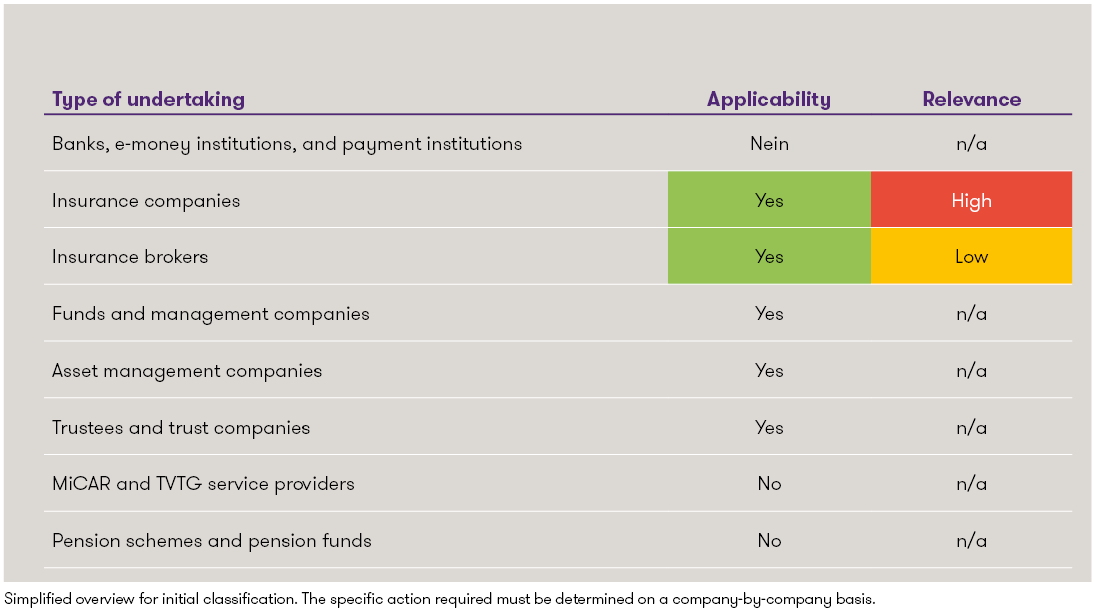
Simplified overview for initial classification. The specific action required must be determined on a company-by-company basis.
2. Overview of the proposal
The Solvency II Review retains the proven three-pillar approach, but introduces significant adjustments across all three pillars:
- Pillar 1 – Quantitative requirements: more market-consistent and more stable capital requirements, along with simplifications for smaller firms.
- Pillar 2 – Governance and risk management: a stronger focus on sustainability, cyber security and macroeconomic analysis, whilst allowing for greater flexibility based on size and complexity.
- Pillar 3 – Reporting and disclosure: more nuanced, clearer and, in some cases, reduced reporting obligations, alongside greater transparency for large groups.
The overarching objectives of the legislative proposal are to strengthen the resilience of the insurance sector, to promote long-term and sustainable investment, and to ensure a more consistent application of the principle of proportionality.
3. Key aspects of the revision
3.1 Strengthening the principle of proportionality
A key element of the proposal is the introduction of the category ‘small and non-complex insurance undertaking’ (Small and Non-Complex Undertaking, SNCU). The criteria for classification as such an undertaking – as well as the corresponding exclusion criteria – are set out in the new Annex 6 to the Insurance Supervision Act (VersAG).
If an insurance undertaking meets the specified risk criteria, it may be classified as ‘small and non-complex’. Following a corresponding notification to the FMA, this classification applies automatically provided the FMA raises no objections within two months. Classification as an SNCU triggers, amongst other things, the following simplifications:
| Area | Relief for SNCUs |
|---|---|
|
Governance
|
Simplified governance requirements
|
|
Key functions
|
Simplification of the rules on the separation of functions; key functions may be combined
|
|
Solvency Capital Requirement (SCR)
|
Simplification of the application of the standard formula forcal culating the Solvency Capital Requirement
|
|
Liquidity management
|
Exemption from the obligation to draw up a liquidity management plan
|
|
Sustainability and Climate
|
Simplifying climate scenario and sustainability analyses
|
|
ORSA
|
Conducting the own risk and solvency assessment (ORSA) only once every two years
|
|
Regular Supvervisory Reporting
|
The regular supervisory report (RSR) may be prepared at longer intervals (in principle, every three years)
|
|
Solvency and Financial Condition Report (SFCR)
|
Simplified quantitative disclosures in the SFCR
|
Undertakings that are not classified as small and non-complex may also apply for individual proportionality measures, but only with the prior approval of the FMA and on the basis of a case-by-case assessment. The new provisions also offer particular advantages for captives, as their typically limited risk profile is taken into account.
3.2 Long-term guarantees and capital requirements
The aim is to free up capital for long-term investments without compromising the protection of policyholders. The methods for calculating the required capital are being revised, including a reduction in the risk margin, a new methodology for the yield curve and a more dynamic volatility adjustment.
In addition, the conditions for using the matching adjustment are being relaxed and the own funds requirements for certain long-term equity investments are being reduced. For small and non-complex undertakings, simplified calculations of the Solvency Capital Requirement will also apply.
3.3 Macroprudential instruments
For the first time, explicit macroprudential instruments are being integrated into insurance supervision. The focus is thus shifting from the solvency of individual undertakings to the stability of the market as a whole:
- Requirement to draw up and continuously update a liquidity risk management plan1
- Systematic incorporation of macroeconomic developments – such as interest rate levels, inflation or market volatility – into risk analyses and ORSA
- Extended powers for the FMA to temporarily restrict dividends, bonuses, share buy-backs or surrender rights in exceptional circumstances
1 Small and non-complex undertakings, as well as undertakings holding the relevant authorisation, are exempt from the requirement to draw up a liquidity risk management plan.
3.4 Strengthening cross-border supervision
This point is of particular importance for Liechtenstein as a business location, as cross-border activities play a key role for all Liechtenstein insurance companies.
The review introduces several new instruments in this regard. Central to this is the newly defined concept of ‘significant cross-border activity’: if an insurance undertaking’s foreign business exceeds certain thresholds, enhanced cooperation mechanisms will in future apply between the supervisory authority of the home state (the FMA in the case of Liechtenstein-based undertakings) and that of the host state. Specifically, mandatory consultation and information-sharing obligations between these authorities are being introduced, as is the possibility of joint assessments and on-site inspections. Should differences of opinion arise between the authorities, EIOPA will assume a strengthened role as mediator. The exchange of information is to be increasingly conducted via shared digital platforms.
3.5 Group supervision
The rules on group supervision are being modernised and clarified. The focus is on clearer criteria for determining when a group exists and which undertakings are to be included, a simplified calculation of group solvency, and simplified approaches for small affiliated undertakings.
In addition, coordination between the supervisory authorities involved will be improved to avoid duplicate supervision. The new macroprudential elements will also apply at group level.
3.6 Reporting
Regulatory reporting will be more finely differentiated and tailored to the size and complexity of the undertaking. An overview of the key changes:
| Element | Change |
|---|---|
|
Expansion of the scope of supervisory and disclosure reporting
|
New disclosures on sustainability, climate and liquidity risks must now be included; depending on the type of risk, these will be incorporated into the ORSA, the RSR, the SFCR and in separate reports to the FMA. In addition, the Quantitative Reporting Templates (QRT) are being revised.
|
|
Structure of the Solvency and Financial Condition Report (SFCR)
|
The report is divided into two parts:
|
|
Deadlines for the SFCR and quantitative reporting forms
|
SFCR now 18 weeks instead of 14 weeks after the end of the financial year; quantitative reporting forms 16 weeks instead of 14 weeks; groups 22 weeks instead of 20 weeks after the end of the financial year
|
|
Frequency of the Regular Supervisory Report (RSR)
|
Change from an annual frequency to a three-year cycle
|
|
Statutory audit requirement for the solvency balance sheet
|
New statutory audit requirement for the solvency balance sheet in the SFCR by an independent auditor (this audit has already been carried out for several years as part of the regulatory audit requirements and is therefore not expected to result in any material change)
|
3.7 Sustainability
In future, insurance companies must have strategies, guidelines, processes and systems in place to identify, measure, manage and monitor sustainability risks over short-, medium- and long-term time horizons.
In addition, specific plans with quantifiable targets must be drawn up to manage financial risks arising from sustainability factors and disclosed annually. Companies with significant exposure to climate risks must also carry out long-term climate change scenario analyses. Exemptions also apply here to small and non-complex companies.
3.8 Further specific amendments
In addition to the Solvency II review, the draft contains adjustments arising from supervisory practice:
- In the case of outsourcing of functions, a prior notification requirement replaces the previous authorisation requirement. The prerequisite remains that the auditor and the FMA must be always guaranteed access to the data of the outsourced service providers.
- Key functions: Clarification that changes to holders of key functions are subject to an approval requirement. This constitutes a legislative adjustment in line with the FMA’s long-standing practice.
- Professional secrecy: The relevant provisions in the Insurance Supervision Act (VersAG) and the Insurance Distribution Act (VersVertG) are repealed; the GDPR/DSG, the AEOI regime and contractual obligations remain applicable.
- PGR and FMAG: Extension of the simplifications regarding sustainability reporting, as well as new fee-triggering events for the new supervisory procedures.
4. Timetable
| Date | Milestone |
|---|---|
|
19 May 2026
|
Publication of the Government’s consultation report
|
|
21 September 2026
|
End of the consultation period
|
|
29 January 2027
|
Deadline for EU Member States to transpose Directive (EU) 2025/2
|
|
30 January 2027
|
Reference date for numerous transitional provisions; application of the EIOPA guidelines
|
|
to be confirmed
|
Entry into force in Liechtenstein – the process of incorporating the Directive into the EEA Agreement is ongoing
|
In parallel, the Commission’s Delegated Regulation and EIOPA’s regulatory and implementing technical standards will come into force. These must be monitored on an ongoing basis, as numerous detailed requirements – in particular regarding thresholds, reporting forms and proportionality requirements – will only be specified at a later stage.
5. Impact on market participants
The draft does not introduce any fundamentally new supervisory requirements, but it does make broad adjustments to existing instruments and extends them in specific areas.
For the Liechtenstein insurance market, this results in greater legal certainty in cross-border business, increased competitiveness and enhanced attractiveness for captive models.
Given the scope and complexity of the new regulatory framework, it is advisable to carry out an early assessment of one’s position. The key focus here is on clarifying one’s own status: whether a company is classified as small and noncomplex or is considered a captive determines the applicability of numerous simplifications.
What action is required?
- Status assessment: Checking whether the criteria for classification as a small and non-complex company are met.
- Carry out a gap analysis across the new qualitative assessment areas: sustainability risks, climate scenarios, cyber security and liquidity risk management.
- Adjustment of scheduling and resource planning to the revised reporting deadlines and cycles.
- Ongoing monitoring of the VersAV revision, as well as EU implementing acts and EIOPA standards.
We are happy to assist you with any questions regarding the Solvency II review or other financial market regulatory matters. We look forward to hearing from you.
Authors