
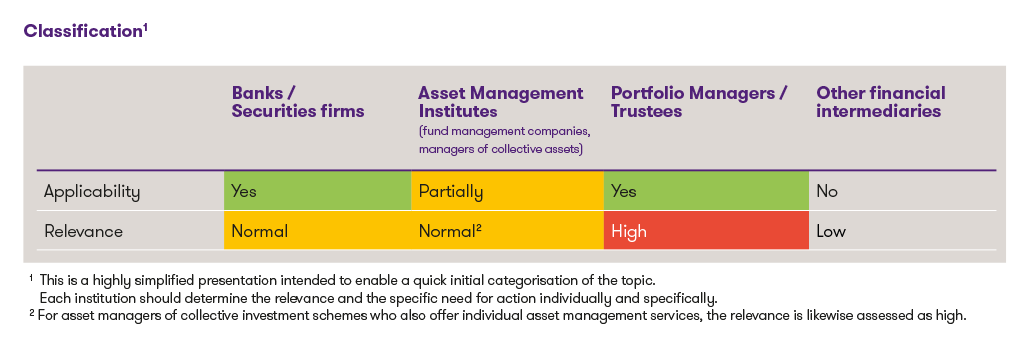
Classification of the changes1
Background
For a long time, illiquid investment products were not a key focus in portfolio management. However, the enforcement proceedings published by FINMA against two different portfolio managers have clearly demonstrated significant risks that can arise for investors if invested assets can no longer be sold or can only be sold to a limited extent. This has heightened awareness of liquidity risks amongst regulators and market participants. In this context, FINMA also published Guidance 03/2026 “Risks associated with the use of products in individual portfolio management” in June 2026. In it, FINMA analyses various other escalation cases and sets out in detail its expectations of portfolio managers, including the management of liquidity risks.3
The escalation cases investigated by FINMA show that liquidity risks often only become apparent when several investors demand the return of their funds or when positions must be sold.
Understanding liquidity risks4
Swiss Banking defines liquidity risk as the risk that an investor cannot sell their investment at any time at reasonable prices. If a financial instrument or a derivative cannot be sold at all, is difficult to sell, or can only be sold at a significantly reduced price, the relevant market is described as illiquid. This definition makes it clear that illiquidity is not so much a separate investment category as a characteristic or risk that can arise with various financial instruments.
When are products considered illiquid?
Swiss financial market law recognises neither a universally applicable definition of illiquid investments nor a separate category of semi-illiquid investments. The distinction used in market practice is therefore primarily of an economic nature.
For FINMA, the focus is not on the conceptual classification but on the actual liquidity of a product and the resulting risk to clients. Various criteria and indicators can be derived from supervisory practice, audit documentation and industry publications, which enable an assessment of product liquidity:
Definitions based on industry rules for portfolio management
Of relevance to this topic is the definition provided by the supervisory organisation OSFINcontrol, as set out in its latest framework audit report. Although it is not a statutory definition, it offers a concrete point of reference. According to this, products are considered illiquid if they cannot be traded on a banking day at representative prices (narrow spread or fair value) or if the notice period exceeds 60 days.
A similar approach can also be found in Swiss Banking’s Portfolio Management Guidelines (self-regulation). These link the ease of trading financial instruments to the existence of a representative market or equivalent tradability provided by the issuer or the bank. In addition, they consider the frequency of redemption options and the length of the notice period:
- liquid, non-traditional collective investment schemes: terminable at least bi-weekly
- other instruments: terminable at least quarterly with a notice period not exceeding 60 days, or terminable at least monthly with a notice period not exceeding 90 days
It is therefore evident that both OSFINcontrol and Swiss Banking assess a product’s liquidity based on three key criteria: trading frequency, the quality of available prices, and the options for termination. The greater the restrictions a product faces in any of these areas, the greater the likelihood that it will be classified as illiquid or, at the very least, as liquidity sensitive.
A look at the former SAM Code of Conduct
The significance of these criteria is also evident in the industry’s historical approach to alternative and less liquid investments. Even the earlier codes of conduct of the Swiss Association of Wealth Managers (SAM), which reflected the industry standard for external portfolio managers until the FinSA came into force, contained guidelines on the use of so-called non-traditional investments. These included, in particular, hedge funds, private equity and property.
The code of conduct was based on the premise that such investments could contribute to the diversification of the overall portfolio. A prerequisite, however, was that they were generally structured in accordance with the fund-of-funds principle5 or otherwise ensured equivalent diversification. At the same time, however, easy tradability or adequate terminability had to be ensured. Furthermore, portfolio managers were required to regulate the use of such investments in a written investment policy and to implement appropriate organisational measures to ensure their careful and professional application.
Investments in precious metals, as well as money and capital market investments in the form of securities and financial instruments, products derived therefrom and combinations thereof, also had to be readily tradable. Specifically, this meant that the products had to be listed on a recognised stock exchange in Switzerland or abroad, or that a representative market for them had to exist. Notwithstanding this, investments could be made, to a limited extent, in widely held securities and financial instruments recognised by the investment community, even if they had limited marketability. In the case of OTC products, however, the issuer had to have a recognised credit rating, and market-conform prices had to be available for the products.
The requirements in force at that time make it clear that liquidity, diversification and internal controls were already regarded as essential components of prudent portfolio management even before the introduction of the current FinIA and FinSA regimes. Even though the earlier codes of conduct are no longer part of the current regulatory framework, they can still serve as a guide and demonstrate the continuity of supervisory expectations in this area.
Illiquidity as a risk across various asset classes
The Swiss Banking brochure “Risks Involved in Trading Financial Instruments” confirms this view. It treats illiquidity not solely as a characteristic of private-market investments, but as a risk that can arise with a wide variety of different financial instruments.
Swiss Banking first highlights the specific characteristics of investments in Emerging Markets. As the political, legal and economic systems of many emerging markets are comparatively young or less established, there are often increased liquidity risks in addition to principal risks.
In the case of alternative investments such as hedge funds, private equity, private debt, infrastructure investments or commodities, longer capital lockups, limited redemption options and only periodic valuations can lead to increased liquidity risks. At the same time, alternative investments have gained considerable importance in recent years. According to the Swiss Asset Management Study 2026, around CHF 381 billion was under management in private markets in Switzerland in 2025, including around CHF 166 billion in private equity.
The tradability of bonds may also be limited, particularly if, following their issue, the securities are predominantly held and are rarely traded. A listing or classification as a fixed-income security therefore does not automatically guarantee a sufficiently liquid secondary market.
Similar considerations apply to collective investment schemes. In the case of property funds in particular, the redemption of units may be restricted due to the lower liquidity of the underlying assets. The enforcement cases published by FINMA also demonstrate that fund structures do not automatically eliminate liquidity risks. For instance, in one case investments were made in separately managed foreign funds that proved to be illiquid, whilst in another case, investors’ funds were invested, directly or indirectly via funds, in illiquid bonds of dubious value.
Finally, Swiss Banking identifies further product categories in which liquidity risks may arise. These include certain structured products as well as unlisted or small-cap public limited companies. In addition, investments subject to sales restrictions may also have reduced tradability.
Lessons learnt from enforcement cases published by FINMA
Precisely because liquidity risks can arise in a wide variety of products and their effects often only become apparent in stress situations, FINMA is placing greater emphasis on the due diligence of the financial instruments used and the risk assessment carried out by financial service providers. The escalation cases analysed in Guidance 03/2026 provide indications of which scenarios, from the supervisory authority’s perspective, pose particular risks.
In particular, FINMA observes risks in relation to foreign funds without equivalent supervision, actively managed certificates (AMCs) and products from foreign, unregulated issuing or structuring companies. Such products are often subject to lower or no requirements regarding supervision, transparency, valuation, liquidity and risk diversification. In some cases, there are also no equivalent requirements for financial reporting and external audit.
Particularly in the case of unregulated products or products without equivalent supervision, the following circumstances may indicate increased risks:
- outstanding Audit Reports
- Change or termination of the audit firm
- lack of audited financial information
- insufficient information regarding the product’s structure, valuation or liquidity
Requirements for dealing with illiquid products
In the context of Circular 2025/2, FINMA states that clients’ knowledge must be assessed separately for each investment category used in the financial service being offered. In the case of portfolio management and portfolio-related investment advice, knowledge and experience must be assessed not in relation to individual transactions, but in relation to the financial service as a whole, considering the characteristics of the investment strategy and the types of products used. A merely general enquiry into experience with financial instruments is not sufficient. This means that, in the case of retail clients, a sufficient understanding of the types of products used is expected, and that this must be adequately verifiable or documented. For professional clients, these expectations are likely to be lower.
When using illiquid investments, appropriate consideration must be given to clients’ financial circumstances, investment objectives, and particularly their liquidity requirements. Of central importance are the investment horizon and the question of whether the invested funds might be required during the intended holding period. The assessment must not be limited to individual investment. Rather, the decisive factor is whether the investment, considering its liquidity characteristics, fits into the client’s overall portfolio. In particular, the following must be considered: actual tradability, redemption restrictions, notice periods or lock-up periods, as well as any valuation uncertainties. In the case of private markets, private debt and comparable investments, a particularly thorough justification of suitability is recommended. The often-long-term commitment of capital, restricted marketability, and limited transparency and valuability should be considered in a comprehensible manner during the suitability assessment.
Attention must also be paid to any conflicts of interest arising in connection with the recommendation of illiquid investments. These should be avoided where possible; otherwise, they must be disclosed to the client in an appropriate manner.
Concentration and bulk risks must also be taken into account. Even if individual illiquid investments may appear suitable in their own right, their cumulative effect at portfolio level can be problematic. This applies in particular where several investments are subject to comparable liquidity, valuation or counterparty risks, or where they collectively tie up a significant proportion of the assets. As part of portfolio management, such concentrations and changes in liquidity characteristics should be monitored on an ongoing basis. Should changes in the liquidity profile arise, it must be assessed whether the investment or portfolio remains consistent with the investment objectives, the investment horizon and the liquidity requirements.
Against this background, client information also plays an important role. Clients should be able to understand the consequences of restricted liquidity and, in particular, be informed that, under certain circumstances, a sale may only be possible after a considerable delay or at a reduced price. Significant product-specific risks and restrictions must be presented transparently.
Finally, the suitability considerations forming the basis of the recommendation or investment strategy must be documented in a manner that is transparent. This relates to clients’ knowledge and experience, their investment horizon, liquidity requirements, the impact on the overall portfolio, and any conflicts of interest. The more complex and illiquid an investment is, the more important it is to have careful and reliable documentation of the suitability assessment.
Conclusion
Liquidity risks associated with the use of financial instruments are not limited to specific asset classes but can arise in a wide variety of financial instruments. An appropriate approach to managing these risks, tailored to the specific financial instrument, client segment and client risk profile, forms part of the due diligence obligations in portfolio management and investment advice. This gives rise to an obligation for financial service providers to take liquidity risks into account appropriately when selecting products, constructing portfolios and providing client information. Recent press releases and the FINMA Guidance show that increased diligence is required, particularly in the case of less transparent or only partially regulated products.
1 This is a greatly simplified overview intended to provide a quick initial understanding of the subject matter. Each institution should determine the relevance and the specific need for action on a case-by-case basis.
2 For managers of collective assets who also offer individual portfolio management services, the relevance is likewise assessed as high.
3 Further information can be found in our article: FINMA Guidance 03/2026 | Grant Thornton
4 The other risks relating to financial instruments discussed in Guidance 03/2026 are not the focus of this article.
5 Diversification is in line with the “fund of funds” principle, provided that the investments are pooled within a single collective investment scheme and are managed according to the multi-manager principle (fund management by several independent fund managers).