
Classification1
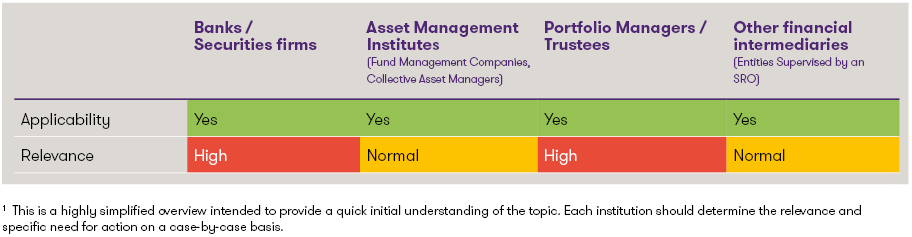
1This is a highly simplified overview intended to provide a quick initial understanding of the topic. Each institution should determine the relevance and specific need for action on a case-by-case basis.
Immediate action required for banks, asset managers and other financial intermediaries
| Swiss Transparency Register | Extension of the Anti-Money Laundering Act to existing advisory services |
|---|---|
|
|
Introduction of the Transparency Register (TJPG)
The TJPG marks the first time that a centralized Swiss transparency register for beneficial owners has been introduced. In the future, all registered legal entities will be required to report their beneficial owners to the register. At the same time, financial intermediaries will have access to the register data to fulfill their due diligence obligations under the AMLA.
The introduction of the registry affects financial institutions in two ways:
Registration and reporting obligations
Banks, asset managers, managers of collective assets and other legal entities must enter their own beneficial owners into the transparency register within the applicable transition period.
Registration is carried out via EasyGov. The actual reporting of beneficial owners can be done after the law has entered into force.
Queries in the Transparency Register for AML purposes
In the future, financial intermediaries will be able to access data from the Transparency Register online, provided this is necessary to fulfill their AML due diligence obligations.
This may be particularly relevant in the following cases:
- Establishing new business relationships
- Updating customer information
- Reviewing complex ownership and control structures
- Checks on beneficial owners
- In-depth due diligence in cases of heightened risk
While there is no legal obligation to consult the registry, it can be assumed that the use of the registry will increasingly become part of regulatory expectations in the future.
Reporting requirement in case of discrepancies
If a financial intermediary identifies discrepancies between the registry data and its own KYC records, the affected company must be requested to correct the information.
If the discrepancy persists despite notification and a reasonable period of time to correct the data in the transparency register, it must be reported to the transparency register within 30 days by the financial intermediary. A corresponding note will then be entered in the register.
New AML obligations for advisors
With the AMLA revision, certain advisory activities are now subject to the AMLA. This applies not only to traditional fiduciaries, law firms or corporate service providers, which may need to join an SRO. It may also affect banks, asset managers and other financial intermediaries, if they offer additional services, beyond those already classified as AMLA-relevant, that are now considered AMLA-relevant advisory services. For example, if a multi-family office that is supervised as an asset manager also assists clients with real estate transactions or with the formation or administration of companies, this could now constitute an AMLA-relevant activity. In this case, the relevant business relationships and transactions must be embedded into the institution’s existing AMLA framework as of 1 October 2026. As a result, the affected customer relationship must be included, for example, in the client list of AMLA-relevant business relationships, the relevant transactions must be monitored, and records must be maintained.
Many institutions currently focus their AMLA compliance exclusively on their activities as financial intermediaries. In the future, they will also need to assess whether individual advisory services constitute an independent AMLA-relevant advisory activity.
Which activities are relevant?
The new regulations specifically cover the provision of assistance to third parties in financial transactions or capital raising in connection with:
- real estate purchases and sales
- the formation of non-operating companies
- administration and management of non-operating companies
- capital contributions and distributions by non-operating companies
- acquisitions or sales of companies
- provision of a registered office and business addresses for extended periods
Special attention is required in real estate transactions. Asset managers or banks may be affected if they actively assist clients with specific real estate transactions and provide corresponding structuring or transaction advice.
Typically within the scope of application
- Structuring and advising on a specific real estate acquisition or sale
- Conducting negotiations between buyers, sellers, banks or other parties involved
- Organizing, managing, or coordinating a transaction process (e.g., buyer selection, bidding process, closing process)
- Active support in financing a specific real estate transaction
- Tax or legal structuring advice directly related to a specific acquisition or sale
- Support for asset deals or share deals with a predominant real estate component
- Support in the formation, management, or use of real estate holding companies
Typically outside the scope of application
- General real estate investment advice not related to a specific property or transaction
- Market and valuation analyses, as well as feasibility and profitability studies
- Technical, commercial, or construction due diligence, as well as the identification of potential investment opportunities
- Real estate management and ongoing administrative tasks following the completion of a transaction
Special provisions for institutions already subject to the Anti-Money Laundering Act
Institutions that are already subject to the AMLA as financial intermediaries and additionally provide such advisory services may subject all AMLA-relevant activities to the existing supervisory regime. However, this requires a corresponding notification to the competent supervisory authority (SRO, AO or FINMA). We recommend that this reporting obligation be fulfilled by 30 September 2026.
This point is of particular practical importance for banks, asset managers and managers of collective investment schemes. An early analysis of the range of services offered and a regulatory classification of the individual services are therefore essential.
Are you affected by the revised Anti-Money Laundering Act (AMLA) and the new Transparency Register (TJPG)?
Grant Thornton assists companies in understanding regulatory changes and supports them in their practical implementation. We are also available as a point of contact for the conceptual and technological aspects of implementation.